
PFAS (per- and polyfluoroalkyl substances) have been produced and used in the United States since the 1940s in both consumer and industrial products. However, public concern about these chemicals has grown significantly over the past decade. This concern, and the increasingly robust array of related research, have resulted in substantive public policy proposals and changes to protect public and environmental health at the state and federal level, including the adoption of the first federal drinking water standards for a handful of PFAS chemicals in 2024. Data released by the Environmental Protection Agency (EPA) in 2025 reflected that an estimated 46 million Americans, including 3.5 million New Yorkers, were served by water systems that had levels above the federal government’s finalized 2024 standards for PFAS in drinking water. That rule, as noted in our previous policy brief, has since been challenged in court, and the Trump administration has stated that it intends to delay enforcement and rescind parts of the rule. More broadly, however, the published EPA data reflect that 73 million Americans are served by water systems in which PFAS were detected (at any level). This underscores the continued salience of public policies to address PFAS in drinking water and across a significant number of uses, sites, and different environmental media.
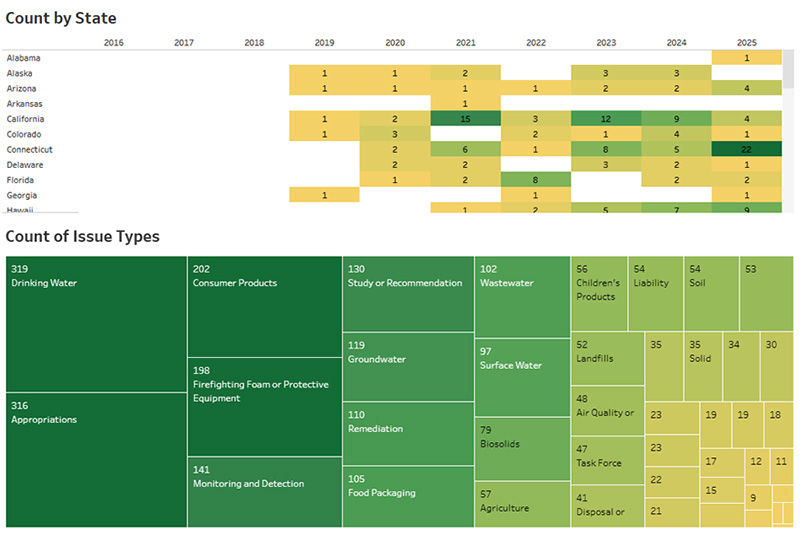
At a state level, the Rockefeller Institute’s PFAS Policy Dashboard has tracked legislation (both introduced and enacted) across all 50 states related to PFAS since the first such bills were introduced in 2016. These were coded based on the focus of the legislation (such as drinking water, consumer products, appropriations, agriculture, etc.), which are often, though not always, multiple. This update adds 2025 legislation and laws to the database, making 10 years of data now available.
Broader Trends
Including all years in the dashboard, 2016–25, there are now 1,056 bills that have been introduced or enacted across 44 states. The five states with the most legislation cumulatively introduced or enacted are: Minnesota (113), Michigan (69), New Hampshire (64), Massachusetts (59), and New York (57). It is important to note (as stated in the limitations section) that the dashboard cannot account for how different states choose to track their bills and, in particular, whether or not they link together the “same as” bills in each house of a legislature (so that they are not inadvertently double-counted).
In 2025, we identified 195 pieces of state legislation related to PFAS, the highest number of bills included in the dashboard for a given year. Those bills were introduced across 40 states, with the most being introduced in Minnesota (29), Connecticut (22), Massachusetts (11), Hawaii (9), and Rhode Island (9). The states with the most bills enacted into law in 2025 were Connecticut (5) and Illinois, New York, Rhode Island, and Virginia (with 3 each). As reflected in the table below, of the 195 bills introduced last year, 35 were enacted into law.
Three new states—Alabama, Missouri, and Montana—introduced legislation related to PFAS in 2025. That leaves just six states—Idaho, Kansas, Nebraska, North Dakota, South Dakota, and Wyoming—that have not introduced or enacted any legislation relating to PFAS (though they may have taken other regulatory actions).
PFAS Laws and Legislation by State, 2016-25
| State | 2016-25 Laws | 2016-25 Legislation | 2016-25 Grand Total | 2025 Laws | 2025 Legislation | 2025 Total |
| Minnesota | 11 | 102 | 113 | 2 | 27 | 29 |
| Michigan | 14 | 55 | 69 | 1 | 3 | 4 |
| New Hampshire | 21 | 43 | 64 | 2 | 1 | 3 |
| Massachusetts | 5 | 54 | 59 | 0 | 11 | 11 |
| New York | 21 | 36 | 57 | 3 | 4 | 7 |
| Maine | 27 | 27 | 54 | 1 | 3 | 4 |
| North Carolina | 7 | 46 | 53 | 0 | 4 | 4 |
| Rhode Island | 14 | 37 | 51 | 3 | 6 | 9 |
| California | 25 | 21 | 46 | 0 | 4 | 4 |
| Connecticut | 12 | 32 | 44 | 5 | 17 | 22 |
| Illinois | 9 | 31 | 40 | 3 | 4 | 7 |
| Pennsylvania | 3 | 37 | 40 | 0 | 6 | 6 |
| Vermont | 8 | 31 | 39 | 1 | 3 | 4 |
| Washington | 19 | 14 | 33 | 2 | 3 | 5 |
| Wisconsin | 1 | 27 | 28 | 0 | 5 | 5 |
| Hawaii | 1 | 23 | 24 | 0 | 9 | 9 |
| New Jersey | 1 | 21 | 22 | 0 | 6 | 6 |
| Maryland | 9 | 12 | 21 | 0 | 3 | 3 |
| Indiana | 3 | 15 | 18 | 0 | 4 | 4 |
| Virginia | 9 | 8 | 17 | 3 | 2 | 5 |
| Florida | 5 | 10 | 15 | 1 | 1 | 2 |
| Arizona | 1 | 11 | 12 | 0 | 4 | 4 |
| Colorado | 10 | 2 | 12 | 0 | 1 | 1 |
| Oklahoma | 0 | 11 | 11 | 0 | 5 | 5 |
| Oregon | 4 | 7 | 11 | 2 | 2 | 4 |
| Alaska | 3 | 7 | 10 | 0 | 0 | 0 |
| Delaware | 5 | 5 | 10 | 1 | 0 | 1 |
| Iowa | 0 | 10 | 10 | 0 | 0 | 0 |
| West Virginia | 3 | 7 | 10 | 0 | 1 | 1 |
| Kentucky | 3 | 6 | 9 | 0 | 1 | 1 |
| Texas | 0 | 9 | 9 | 0 | 6 | 6 |
| South Carolina | 1 | 6 | 7 | 1 | 1 | 2 |
| Nevada | 2 | 3 | 5 | 1 | 2 | 3 |
| New Mexico | 2 | 3 | 5 | 1 | 1 | 2 |
| Ohio | 1 | 4 | 5 | 0 | 1 | 1 |
| Utah | 4 | 1 | 5 | 1 | 0 | 1 |
| Georgia | 1 | 2 | 3 | 0 | 1 | 1 |
| Montana | 1 | 2 | 3 | 1 | 2 | 3 |
| Mississippi | 0 | 2 | 2 | 0 | 1 | 1 |
| Missouri | 0 | 2 | 2 | 0 | 2 | 2 |
| South Dakota | 0 | 2 | 2 | 0 | 2 | 2 |
| Tennessee | 0 | 2 | 2 | 0 | 0 | 0 |
| Alabama | 0 | 1 | 1 | 0 | 1 | 1 |
| Arkansas | 1 | 0 | 1 | 0 | 0 | 0 |
| Louisiana | 1 | 0 | 1 | 0 | 0 | 0 |
| Grand Total | 268 | 787 | 1055 | 35 | 160 | 195 |
The most common issues identified cumulatively (2016–25) have also been the top three issues year on year since 2022: drinking water, appropriations, and consumer products. In addition to those issues, firefighting foam or protective equipment has also generally been in the top five issues, while a handful of other issues have floated in and out of the top five. In the table below are the top five (green background) and 10 (red letters) issue types for 2025. In addition, we’ve included children’s products in the table, which was the 11th most common type, as children’s products and consumer products are commonly, but not always, overlapping issue types for bills.
Top 5 and 10 (11) Issue Types in 2025
| Issue Type | 2025 |
| Appropriations | 56 |
| Drinking Water | 54 |
| Consumer Products | 46 |
| Remediation/Mitigation | 40 |
| Firefighting Foam or Protective Equipment | 36 |
| Wastewater | 31 |
| Monitoring and Detection | 28 |
| Study or Recommendation | 27 |
| Biosolids | 26 |
| Agriculture | 25 |
| Groundwater | 23 |
| Children’s Products | 22 |
Continued Trends
Wastewater, Biosolids, Soil, and Agriculture
In our previous update to the Dashboard, we noted that:
This has generally continued to be the case in 2025, though with a slightly different constellation of issue types. Notably, between 2024 and 2025, five interrelated issue types—agriculture, biosolids, groundwater, soil, and wastewater—all saw a marked rise in the number of bills introduced (see table below). This appears to (though it may not only) reflect growing concern about and research related to the presence of PFAS in biosolids produced from contaminated wastewater, as well as the application of those biosolids on agricultural land and their related impacts on soil and groundwater. The Rockefeller Institute’s ongoing series on PFAS in biosolids further explores some of those intersections.
| Issue Type | ’16 | ’17 | ’18 | ’19 | ’20 | ’21 | ’22 | ’23 | ’24 | ’25 | Grand Total |
| Agriculture | — | — | — | — | 1 | 4 | 6 | 1 | 20 | 25 | 57 |
| Biosolids | — | 2 | — | 1 | 8 | 10 | 5 | 8 | 19 | 26 | 79 |
| Groundwater | — | 7 | 3 | 12 | 12 | 25 | 12 | 6 | 19 | 23 | 119 |
| Soil | — | 2 | 3 | 3 | 6 | 9 | 4 | 2 | 8 | 17 | 54 |
| Wastewater | — | 2 | — | 3 | 14 | 13 | 8 | 12 | 19 | 31 | 102 |
Defining PFAS
We first included PFAS definitions into the dashboard beginning in 2023. Specifically, we tracked if a bill included either directly or indirectly a definition of PFAS—beyond simply stating that PFAS are per- and polyfluoroalkyl substances—and we categorized those definitions into a handful of types.
As discussed previously, definitions of PFAS have increasingly become the terrain on which policy about these contaminants is negotiated. Definitions of PFAS may lean either towards broader and more inclusive definitions or towards narrower ones—determining the scope of what and whose actions fall under the law (or proposed law). It is not uncommon for both broader and more narrow definitions to be used in the same state’s laws—where perhaps a broader definition is used with respect to prohibitions on consumer or children’s products) that contain intentionally added PFAS, while a more specific subset or list of PFAS defines those that fall under certain testing and monitoring requirements. PFAS definitions determine in a significant way the scope of a law or regulations’ purview, given that there are nearly 15,000 PFAS compounds listed in the EPA’s chemical database (CompTox). The difference between regulating the most common compounds (namely, PFOA and PFOS) and regulating all such compounds is therefore very significant.
| 2023 | 2024 | 2025 | |
| Total Bills | 183 | 181 | 195 |
| Bills With a Definition | 52 | 64 | 70 |
| Bills With “One Fully Fluorinated” Definition | 42 | 60 | 53 |
| Total Laws | 47 | 40 | 35 |
| Laws With a Definition | 11 | 13 | 12 |
| Laws With a “One Fully Fluorinated” Definition | 6 | 11 | 10 |
Of the 195 bills introduced across state legislatures in 2025 that were related to PFAS, 73 included a definition, while 125 did not. Of the legislation that included a definition, 55 bills included a “one fully fluorinated” definition, the broadest or most inclusive definition used. This data appears to reflect the continued trend of state lawmakers to use this definition in legislation over others. It is important to note, as referenced above, that this definition may be more commonly used with respect to certain types of legislation.
Essential Uses
The framing of “essential uses” has newly appeared as a legislative approach over the last few years. As evidenced in the dashboard, for close to a decade, legislation related to PFAS has grown significantly, rising from just a couple of bills in a single state in 2016 to 195 pieces of legislation across 40 states in 2025 (44 states in total across all years in the dashboard), reflecting substantive efforts to address its widespread and innumerous uses across many sectors.
As we noted in the prior update, this more one-by-one legislative or regulatory approach to addressing chemical contaminants in policy is often referred to as a game of ‘whack-a-mole.’ The regulation of essential or unavoidable uses (sometimes also referred to as critical uses in certain domains, such as aerospace and military applications) therein presents an alternative meta-regulatory framework—one that could be used more broadly with other contaminants.
The model for this new legislative framework stems most directly from “Amara’s Law” in Minnesota, part of an omnibus environmental bill, HF 2310/SF 2438 of 2023. That law, which was passed in 2023, directed the Minnesota Pollution Control Agency (MPCA) to develop rules in order to determine currently unavoidable uses of PFAS in products. Those provisions are set to be implemented between 2025 and 2032. The first phase of that law took effect in January 2026, with the prohibition of selling or distributing certain categories of products containing intentionally added PFAS. At present, the MPCA is developing further rules with respect to the determination of unavoidable uses of PFAS in products—the public comment period for which closes at the end of March 2025. At the federal level, Minnesota representatives have also recently reintroduced legislation that mirrors Amara’s Law in prohibiting nonessential uses of PFAS in products.
The concept of essential uses with respect to regulating PFAS has been discussed by scholars in environmental health research since at least 2020, who were building on the framework of the Montreal Protocol to phase out uses of chlorofluorocarbons (CFCs), which are known to damage the ozone layer.
In 2024, nine bills introduced across eight states were coded as “essential uses”—meaning that, like Amara’s Law, the bill (or part of it) approached the regulation of PFAS through the designation of certain uses or products as either necessary or unavoidable (as opposed to other unnecessary or avoidable uses that would be restricted). Likewise, in 2025, nine bills were introduced pertaining to essential uses, but four of those nine were introduced in Minnesota, whereas none had been introduced in the state the year prior. All four of the bills in Minnesota sought to exempt certain items from being regulated under provisions of Amara’s Law.
As in the prior year, one bill related to essential uses was enacted. In 2024, the Comprehensive PFAS Ban Act of 2024 was enacted into law in Rhode Island (S2152 or Chapter 345). And in 2025, New Mexico enacted the Per- & Poly-flouroalkyl Protection Act (HB212 or Chapter 102 of 2025). That act, among other provisions, included authorizing the state’s environmental improvement board to adopt regulations related to PFAS and directing the board to “identify currently unavoidable uses of a per- or poly-fluoroalkyl substance that are essential for health, safety, or the functioning of society and for which alternatives are not reasonably available unless exempted.”
| Issue Type | 2016 – 2022 | 2023 | 2024 | 2025 | Grand Total |
| Essential Uses | – | 1 | 9 | 9 | 19 |
New Codes—Precursors
We include a few new codes in the 2025 data. Notably, fertilizer pertained to the content of the increased number of bills related to agriculture. In addition, we added a code for precursors. Precursors are chemicals that, after a given type of reaction, produce another chemical(s)—in this case, PFAS. Recent and ongoing scholarship has discussed how, in the context of increasing regulation of PFAS, some industries and manufacturers have moved toward using what are called polyfluorinated substances. These substances are often precursors to PFAS, allowing the use to move outside of regulation, even if/as the terminal components may still result in PFAS entering the environment.
There were five bills related to precursors identified (though it’s possible two of those bills are duplicates of each other; however, we could not verify as such). These bills were introduced across three states: Massachusetts (2), Vermont (1), and Virginia (2). Those introduced in Massachusetts and Vermont both addressed children’s and consumer products, and the instances of “precursors” in them were with respect to specifying the meaning of “intentionally added” PFAS in products. The two bills in Virginia, on the other hand, both cited an existing definition of PFAS in state law that includes precursors in addressing environmental media and waste.
Conclusion
As states continue to take legislative action to address PFAS, the PFAS Policy Dashboard will track trends related to the issues that are being addressed across states, and the Rockefeller Institute will continue to provide further in-depth research and analysis of those issues through our policy briefs and blog series. It is our hope that the centralization and sharing of legislative approaches to the litany of issue areas PFAS involves will provide more models for states to draw on as they address the PFAS challenges in their own backyard.
ABOUT THE AUTHOR(S)
Laura Rabinow is director of research at the Rockefeller Institute of Government.
Mathilda Scott is a policy analyst at the Rockefeller Institute of Government.