
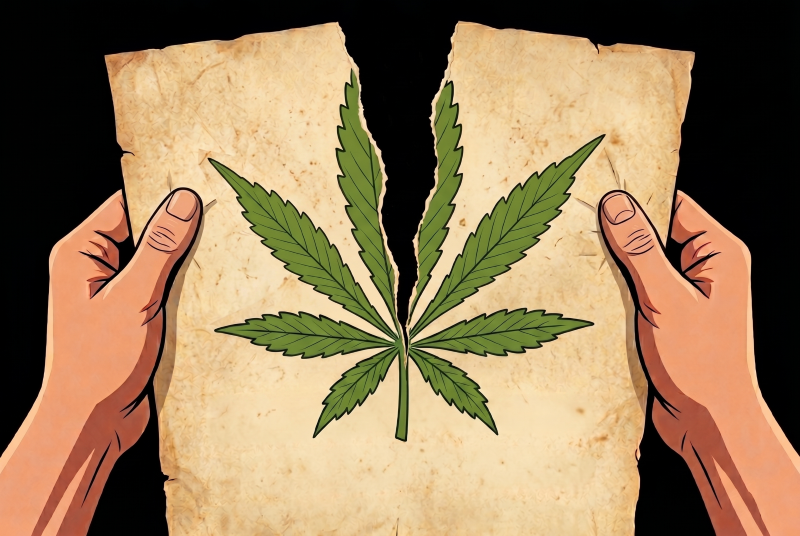
For more than a decade, cannabis policy in the United States has steadily moved toward legalization. Since Colorado and Washington became the first states to legalize adult-use cannabis in 2012, a growing number of states have adopted regulated cannabis markets. Today, 40 states have legalized medical and/or recreational cannabis. Approval of the legalization of cannabis, for either medical or recreational use, continues to be strong among Americans.
However, there are signs that there may be a turning of the tide in 2026 regarding continued cannabis legalization. While legalization continues to advance in some places, a countermovement is emerging that seeks to roll back existing programs, restrict cannabis markets, or prevent new legalization efforts from reaching voters. These efforts take a few different forms: ballot initiatives aimed at repealing legalization laws, legislative revisions that alter voter-approved measures, and procedural changes designed to make it harder for cannabis reform campaigns to qualify initiatives for the ballot. Taken together, they suggest that the future of cannabis policy in the United States may be uneven—that it may reflect not only the kind of expansion many have come to expect, but also a concurrent legislative and regulatory retrenchment.
Setback of Existing Cannabis Programs
The most dramatic rollbacks of cannabis policy are the attempts in 2026 to repeal existing cannabis legalization legislation. Several states have seen a push for ballot measures that, if approved by voters, would dismantle their respective regulated recreational cannabis markets. In Massachusetts, a proposed ballot measure would maintain the state’s medical cannabis program but repeal the legislative language that governs the possession, use, distribution, cultivation, and taxation of cannabis for recreational purposes. Limited possession of nonmedical cannabis (1 ounce or less for those 21 years or older) would still be permitted. Massachusetts voters approved recreational cannabis in 2016. Though the 2026 ballot measure has been certified by the state attorney general, it is not yet guaranteed to be on the ballot; the measure must either be approved by the state legislature or additional signatures will need to be collected for it to go before voters in 2026. The measure has also been the subject of legal action: an initial challenge to the process of collecting signatures for the initiative, alleging deceptive practices, was dismissed, while a lawsuit by Massachusetts cannabis businesses to prevent the ballot measure from proceeding is still working its way through the legal process.
A similar repeal effort in Arizona is taking place through a potential ballot measure. The Arizona Repeal Marijuana Legalization Initiative has been cleared to begin collecting signatures and has until July 2, 2026, to obtain 255,949 valid signatures necessary for the measure to move toward inclusion on the 2026 ballot. Much like the effort in Massachusetts, the Arizona initiative would overturn many of the provisions of the state’s successful 2020 ballot measure, Proposition 207, which legalized adult-use cannabis. Similarly, the commercial market for recreational cannabis would be eliminated, but, unlike Massachusetts, limited home cultivation would still be permitted. A repeal effort was also launched in Maine, but failed to gather enough valid signatures for consideration on the 2026 ballot. However, supporters plan to try to qualify for the 2027 ballot.
… efforts to reverse legalization after a commercial cannabis market is established are unprecedented. If any of these proposals reach the ballot and succeed, they would become the first examples of voters dismantling a regulated cannabis industry that has already taken root.
Additionally, in his final State of the State address, Oklahoma Governor Kevin Stitt called on the state legislature to put forth a ballot measure for voters to reconsider the state’s medical cannabis program. “One of the greatest threats to public safety is the out-of-control marijuana industry. When Oklahomans voted to legalize medical marijuana in 2018, we were sold a bill of goods…. Send the marijuana issue back to the vote of the people and shut it down.”
Opponents of legalization argue that the commercial cannabis industry has produced unintended consequences, including youth access concerns, impaired driving risks, uncertainty of public health impacts, and aggressive marketing practices. Supporters counter that eliminating legal markets would likely revive illicit cannabis sales and remove a source of tax revenue.
While states have frequently debated whether to legalize cannabis, efforts to reverse legalization after a commercial cannabis market is established are unprecedented. If any of these proposals reach the ballot and succeed, they would become the first examples of voters dismantling a regulated cannabis industry that has already taken root. Regardless of the outcome, these repeal campaigns signal that legalization may not necessarily be a permanent policy settlement.
Legislative Rollback
Another challenge for cannabis legalization has been the recent trend in state legislatures of altering policy language that has been passed by ballot measure, sometimes in ways that fundamentally change what voters initially supported. This has been the case recently in Ohio. In November 2023, voters approved Issue 2, a ballot initiative legalizing recreational cannabis for adults 21 and older with 57 percent of the vote. However, because Issue 2 was enacted as a statutory initiative rather than a constitutional amendment, the Ohio General Assembly retained the authority to amend or repeal its provisions after passage—a power that lawmakers exercised once legalization was approved.
In 2026, Ohio state lawmakers then enacted Senate Bill 56 that made what opponents claim are significant changes to the state cannabis law and overrides the will of voters. It limited certain THC levels, re-criminalized some conduct, such as public consumption or bringing cannabis legally purchased in another state back to Ohio, and eliminated protections against discrimination based on cannabis use for housing, employment, and organ donation. Home cultivation limits were decreased from twelve plants to six. The recreational sales tax on cannabis was increased and redirected toward law enforcement and county jail construction, rather than the previously approved allocation to local government programs, substance abuse programs, and social equity programs. The bill also addressed the regulation of intoxicating hemp products, such as THC beverages, in the state.
A counter attempt was made by advocates to garner enough signatures for an initiative on the 2026 ballot that would have been a referendum on these changes made by the state legislature. On March 18, 2026, the campaign announced, however, that they had failed to secure the requisite signatures and the ballot measure attempt would not be successful. Consequently, the provisions of Senate Bill 56 went into effect on March 20, 2026, though legal challenges persist.
A recent state supreme court decision in Arkansas has also opened the door for legislative changes to voter-approved ballot measures. The court case arose after two licensed dispensaries challenged a series of legislative changes to the Arkansas Medical Marijuana Amendment, a constitutional amendment approved by voters in 2016. The plaintiffs argued that the legislature’s modifications—such as outlawing smoking or vaping cannabis, limiting THC content of edibles, and prohibiting advertising—improperly altered a voter-initiated constitutional amendment. In a unanimous decision, however, the court held that the Arkansas Constitution allows the General Assembly to amend citizen-initiated constitutional amendments with a two-thirds vote in both legislative chambers, upholding the legislature’s changes to the medical marijuana amendment. This decision overturned the precedent previously set in the 1951 Arkansas Game and Fish Commission v. Edgmon ruling.
These examples highlight the tensions in the balance of power between voters and state lawmakers and legislative alteration of voter initiatives, even after passage.
Roadblocks to Legalization
In some states, opponents of cannabis legalization have focused less on rolling back existing laws and more on preventing new legalization measures from reaching voters in the first place. Florida has become one of the most prominent battlegrounds in this fight, creating roadblocks to derail ballot measures from success. Recreational cannabis legalization efforts illustrate the evolution of the initiative process in the state.
In 2006, the threshold for a ballot measure’s passage was raised from a simple majority to 60 percent (ironically, by a ballot measure that passed with 57 percent support). After overcoming many legal challenges to appear on the ballot, the 2024 cannabis legalization initiative was ultimately unsuccessful as it only garnered 55.9 percent of the vote—not enough to meet the state’s heightened threshold. Supporters immediately began preparing for another attempt to get a legalization initiative on the 2026 ballot. In the meantime, the Florida legislature passed House Bill 1205, which created additional requirements for a measure to qualify for the ballot. Those requirements included that those who sign a petition must now include certain personal information with their signature (valid driver license number, Florida ID card number of the last four digits of their social security number), registration and training for petition collectors, a $1 million bond from sponsors once they achieve 25 percent of the necessary signatures, a reduced timeline for submitting petition forms, and the establishment of new fines and potential felony charges for violation of rules.
In early 2026, it was announced by state officials that the proposed recreational cannabis measure did not obtain enough valid signatures to qualify for the ballot. The Florida secretary of state invalidated more than 70,000 of the signatures submitted, including signatures from “inactive voters” who are registered to vote but had not confirmed their address. Though supporters of the ballot measure filed a lawsuit to challenge the dismissal of signatures, the Florida Supreme Court ultimately dismissed the case, eliminating the possibility of the measure going before voters in 2026.
In some states, opponents of cannabis legalization have focused less on rolling back existing laws and more on preventing new legalization measures from reaching voters in the first place.
Idaho is one of the few states in the nation that has not legalized cannabis in any capacity. That could change in 2026. The Idaho Medical Marijuana Legalization Initiative has been cleared to begin collecting the 70,725 valid signatures needed by May 1, 2026, in order to appear on the 2026 ballot. However, what is unusual is that a ballot measure that has already qualified for election day—and would appear alongside the medical cannabis legalization measure if it qualifies asks citizens to give up their ability to initiate state statutes that would legalize cannabis and other psychoactive substances, allowing only the legislature to have the authority to legalize. Under this ballot measure (Idaho HJR 4), which was a legislatively referred constitutional amendment, future ballot measures would no longer be a tool for the citizens of Idaho on issues related to cannabis legalization; legislative action would be the only path forward if approved.
While states, such as Florida, have made passing citizen-initiated ballot measures more difficult by changing signatory requirements or increasing the voter threshold for success, Idaho’s HJR 4 measure would take that a step further with the complete restriction on its usage for certain issue areas. The Idaho legislature also signaled its displeasure with the proposed medical cannabis initiative by passing Senate Concurrent Resolution No. 127, which urges Idaho voters to reject the effort to bring the Idaho Medical Cannabis Act to the ballot. If both measures appear on the 2026 ballot, Idaho voters will be faced with an ironic choice: they can approve medical cannabis by ballot measure, give up their right for future cannabis measures to move forward, or do both.
In these states, the focus of proponents of such measures is not on policy recalibration but on preventing a voter-initiated policy discussion from even occurring in the first place.
Conclusion
The developments unfolding in 2026, while not completely new, further a trend in how states are handling cannabis policy and illustrate how the political debate is far from settled.
Rollback campaigns in states like Massachusetts, Maine, and Arizona could test whether voters are willing to reconsider legalization after several years of regulated markets. Legislative revisions in states like Ohio and Arkansas highlight the ability of lawmakers to reshape voter-approved laws. And procedural changes in states such as Florida and Idaho reveal how political institutions can influence whether cannabis policy questions reach voters at all.
The political fight over cannabis is evolving. The next phase will involve not only expanding legalization to new states but also defending existing programs from repeal, restriction, or regulatory retrenchment. In that sense, the cannabis policy battles of 2026 may mark the beginning of a new chapter in the long-running debate over cannabis in the United States—one defined less by rapid expansion and more by contested consolidation.
ABOUT THE AUTHOR(S)
Heather Trela is director of operations and fellow at the Rockefeller Institute of Government