
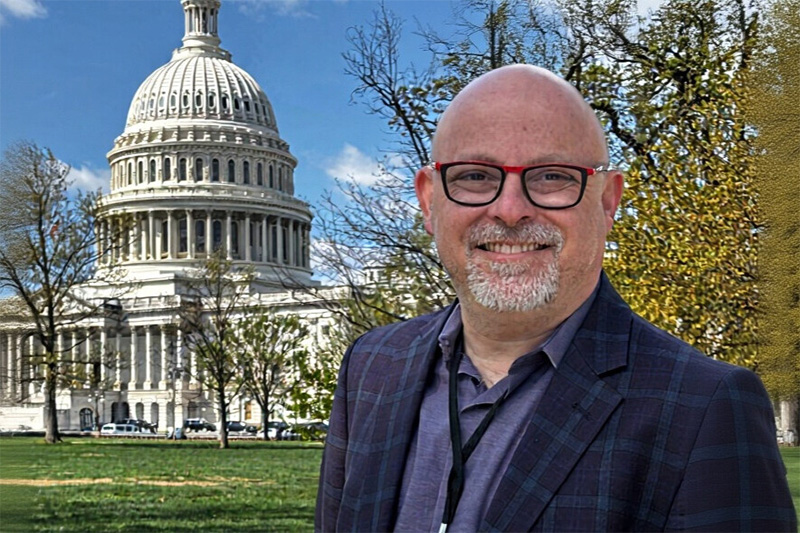
Experts with the Regional Gun Violence Research Consortium (RGVRC) address different facets of firearm violence from a variety of perspectives and disciplines. In this new series, get to know our experts and learn more about their contributions to better understand, prevent, and respond to the public health crisis of firearm violence. Get to know Eric Fleegler, a scholar with the RGVRC, a physician in the Division of Pediatric Emergency Medicine at Massachusetts General Hospital (MGH), and a Senior Research Investigator at the MGH Gun Violence Prevention Center.
Why do you study gun violence? Why is this an important area of research, and how do you see your work helping to address this issue?
I have been a health services researcher for 24 years, and over time, my research has focused on health-related social needs, health inequities, and, for the past 14 years, firearm violence. At its core, my research is driven by injustice and by the belief—shaped by both evidence and lived experience—that society need not, and should not, remain as it is.
My first firearm-related article, “Attempts to Silence Firearm Injury Prevention,” was written in 2012 in response to a local Florida newspaper article I read that discussed a possible ban on healthcare providers talking to patients about guns. I was furious. How dare a legislative body dictate what I could say to my patients! And so, I started to read and learn. At that time, approximately 30,000 people were dying each year from guns in the US. Thousands of kids were being hurt and killed by guns.
The story, of course, was a little more complicated, in that its origins began with a pediatrician in the middle of Florida who always asked his patients about firearms in the home. When he spoke to a young family with a six-month-old child, they told him they did not want to discuss this. He later dismissed them from his practice. People heard about this, they became upset, and within a year, the “gun gag law” was passed. An injunction was immediately issued, and ultimately, the 11th Circuit Court of Appeals struck down key provisions, ruling that they infringed on the free speech rights of doctors and patients. Doctors and other healthcare providers can talk to their patients about firearms, they can record details in their medical records, and they can notify the police if they’re concerned about imminent harm. But what they cannot do is discriminate against their patients. I agree with all of this.
Around that time, my colleagues and I, including Dr. Lois Lee, had started evaluating the role of legislation in reducing injury fatalities. We had looked at booster seat laws, primary seatbelt laws, and bicycle helmet laws and found the same patterns—after these laws were passed in a state, fatalities related to the mechanism typically fell 10–15 percent. We had just published our third article when the news came out about the trial of the person who killed Trayvon Martin. Trayvon was the 19-year-old African American male who had, in essence, been followed in his own community and shot and killed by a man who ultimately claimed self-defense under the “stand your ground” laws that Florida had passed. It was heartbreaking.
I asked my friends: What did we know about firearm legislation and its role in reducing fatalities? Amongst us, the answer was nothing. Research to date had not examined this in depth, and we embarked on our first study. I used data from the Brady Center about firearm legislation and data from the CDC about firearm fatalities. Our research showed that states with the most laws compared to states with the fewest laws had a 42 percent reduction in firearm fatalities by homicide, by suicide, and by unintentional deaths. I finished the first draft of the manuscript and sent it to David Hemenway, one of the leading firearm researchers in the United States. Four hours later, the shooting at Sandy Hook Elementary School occurred. That combination of events lit a fire under me that has never been extinguished.
What is your research focus related to gun violence? What are you currently researching?
My firearm research has evolved over time. A lot of my research has focused on the epidemiology of firearm violence, understanding the massive disparities in who is hurt and killed by guns, where this occurs, and its relationship to race, ethnicity, and poverty. I am particularly interested in understanding the role of firearm violence and its destructive effect on children and their families, as well as the healthcare utilization and cost associated with this. I have done additional studies related to firearm legislation, which is an incredibly complex area of study given the myriad reasons why people own guns, where they own guns, the distribution of guns, and even how the guns are stored. We have looked at the role of child access prevention laws, domestic violence laws, background checks, and tried to tease apart which laws make the biggest difference, and continue to think about how we make things better so that we no longer see an eight-fold difference in firearm fatality rates across states. And so that we don’t have two-, three-, and four-year-olds who find guns and kill themselves or their siblings.
We have studied the historic role of redlining and seen the deleterious effects of 1930s racist federal housing policies on the distribution of where people die by guns over 80 years later. I have recently started to work on interventions to reduce firearm fatalities and have received a grant from the New Jersey Gun Violence Research Center, with my colleague Jennifer Dineen, for a randomized control trial of a secure firearm storage app that we are designing to help families with young children decide which secure storage devices best meet their needs.
What do you hope that people can take away from the research you are conducting?
Ultimately, I believe my research serves multiple purposes. It is important to document the massive disparities that exist to bring attention to the trends in firearm fatalities over the years, so that we all understand the significance of this issue. My greatest goal is to make change possible. Studying legislation provides insight into the opportunities to meaningfully reduce firearm violence. I’ve seen my research quoted by state legislatures around the country when developing new laws, and that’s incredibly fulfilling. I’ve also seen some of the research that I, along with my colleagues, have written quoted by the Supreme Court of the United States when writing their decisions. That’s pretty exciting to see, and I think it speaks to the possibility of change.
Now, my greatest goal is to figure out the interventions that can be implemented one-on-one with families and at the community level to reduce gun violence. I recently started some work with colleagues at the MGH Gun Violence Prevention Center on veterans’ suicide. As a pediatrician, I have not done much work around Veterans, but they have some of the highest suicide rates in the country, and the opportunity to work to improve this is exciting. I love collaborative work, and I’ve gotten to know so many colleagues around the country who are passionate about reducing firearm violence. I believe the work that we all do together will make a significant difference in the reduction of gun violence injuries and fatalities, and I believe we will make our country a safer place for everyone.
Learn more about Eric and his work for the Regional Gun Violence Research Consortium below.