
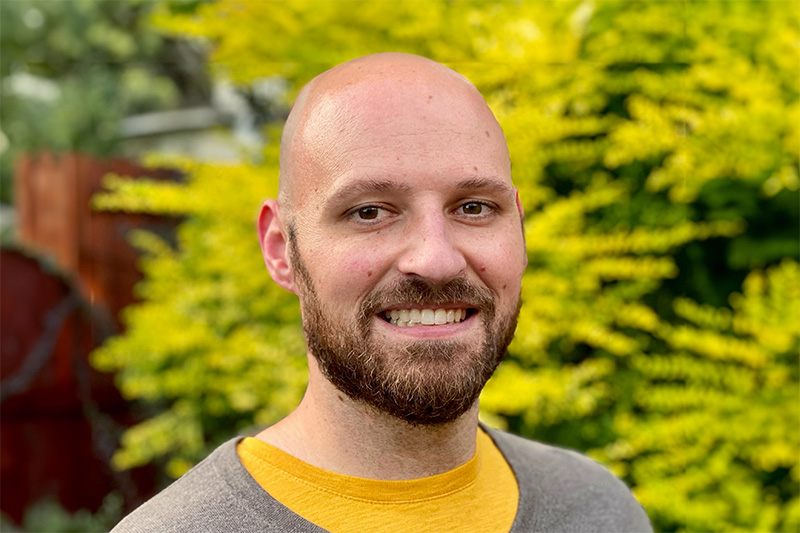
Experts with the Regional Gun Violence Research Consortium (RGVRC) address different facets of firearm violence from a variety of perspectives and disciplines. In this new series, get to know our experts and learn more about their contributions to better understand, prevent, and respond to the public health crisis of firearm violence. Get to know Christopher Collins, a member of the RGVRC and an assistant professor of social work in the School of Social Work at Salem State University.
Why do you study gun violence? Why is this an important area of research and how do you see your work helping to address this issue?
My ‘why’ for studying gun violence is multifaceted and, in many ways, deeply personal. When I was 20 years old, my dad, Jim, died in a very public police-assisted suicide. Because of that, I never thought I’d have the emotional capacity to do this type of research given my proximity to it in my personal life.
In 2018, prior to starting my PhD program, there was a shooting at a yoga studio near my house. Two women affiliated with Florida State University (my alma mater) were murdered: Maura Binkley and Dr. Nancy Van Vessem. I’d taken yoga classes at this studio, and though I didn’t know either of these women personally, it struck me deeply.
We would later learn that the shooter identified as an involuntary celibate (incel), and this set me on my path towards both completing a PhD and researching incel-perpetrated violence against women. As I started down that path, it quickly occurred to me that there was a commonality among the deadliest incel attacks: guns. Suffice it to say, that was all I needed to pivot my focus towards firearms.
If you’d asked me before beginning to develop this research agenda how much guns are woven into the fabric of American society, I wouldn’t have had a clue, and I probably would’ve grossly understated their cultural and personal significance to people. I’d like to believe that my research helps to do multiple things.
First, I believe my research helps to shine a bright light on other types of gun owners. We often have an image in our mind’s eye of who gun owners are. While that image isn’t necessarily wrong, I do think it’s incomplete. My research helps people to better understand that plenty of queer (LGBTQ+) people own guns. Sometimes for similar reasons as their heterosexual, cisgender counterparts, but often for different and compelling reasons. The world isn’t always a safe place for queer people, and that’s been made abundantly clear through my research.
Second, my research seeks to have practical significance in the lives of those charged with screening, assessing, and treating people with mental health conditions. My dissertation focused on training mental health providers to screen their clients for access to firearms and provide appropriate consultation on storage options. We often shy away from taboo topics, and I think we’re doing a disservice to our clients by not having these discussions. I can say that as a licensed social worker who never used to ask about firearms. Knowing what I know now, I think that’s wild given how the presence of a firearm in somebody’s home exponentially increases their risk for violent injury and death.
What is your research focus related to gun violence? What are you currently researching?
My research focuses on two, often intersecting areas: first, incel-perpetrated violence against women, and second, firearm violence with a particular focus on ownership among LGBTQ+ people and screening mechanisms for mental health providers. Currently, we (my research colleagues and I) are working on a few different projects. We’re in the process of wrapping up two different manuscripts related to the suicide experiences of LGBTQ+ people and, more specifically, firearm owners. We’re also in the early stages of completing a latent class analysis on our sample of LGBTQ+ firearm owners to better understand the different profiles of LGBTQ+ firearm owners. None of this work would be possible without the incredible and generous support of my two amazing colleagues, Dr. Liz Tomsich of UC Davis and Dr. Allie Bond of the New Jersey Gun Violence Research Center. I’m also excited to undertake a new qualitative project examining the experiences of LGBTQ+ firearm violence survivors.
What do you hope that people can take away from the research you are conducting?
I think the thing I most want people to take away from my research is that people own guns and that doesn’t make them bad people. I know a lot of non-gun owners who hold really strong, largely unfavorable, views of gun owners. It’s stigmatizing, demoralizing, and isolating. I believe that if more people felt like they could openly talk about their firearm ownership status without being judged or ridiculed, we’d be able to move the needle on firearm injury and death, especially firearm-related suicides, which make up so much of the violent injury and death total.
The other thing I’d hope people take away from my research is to not hold such narrow views of who owns firearms. Realistically, we’ve got more civilian-owned firearms than we do people. The likelihood that you regularly encounter a gun owner is pretty high, and they probably look very different than the image in your head. Finally, I’d hope that people, especially mental health providers, take away the importance of screening for access to firearms. A few simple questions could save somebody’s life. I think we have a moral and ethical obligation to make sure this regularly happens.
Learn more about Chris and his work for the Regional Gun Violence Research Consortium below.